Newtown Creek Thermal Community, Inc.
Finding common ground through infrastructure.
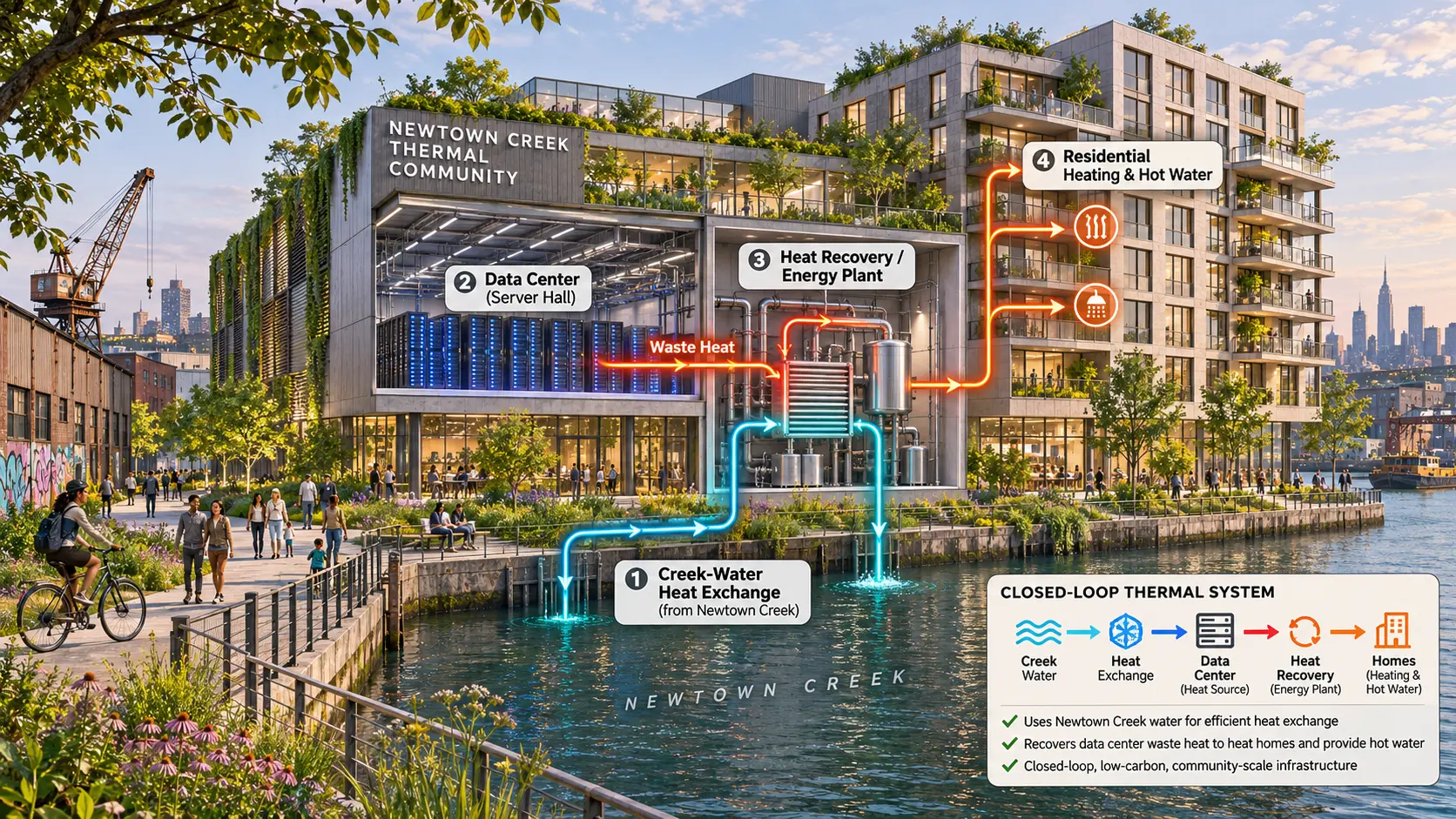
New York City needs digital infrastructure, housing and sustainable energy solutions. Too often, these needs are addressed independently. Newtown Creek Thermal Community, Inc. seeks to find common ground. Our proposed development integrates data-center infrastructure with closed-loop thermal exchange and residential heat recovery along Newtown Creek, a waterfront shaped by nearly a century of industrial contamination. By recovering data-center waste heat for residential use and exploring how data-center revenues could support housing development, we aim to align technological growth with environmental responsibility and community investment. Our objective is to make digital infrastructure an asset for the communities that host it.
Newtown Creek Thermal Community, Inc. seeks to align digital infrastructure, thermal energy recovery and housing development to create shared economic, environmental and community value for New Yorkers.
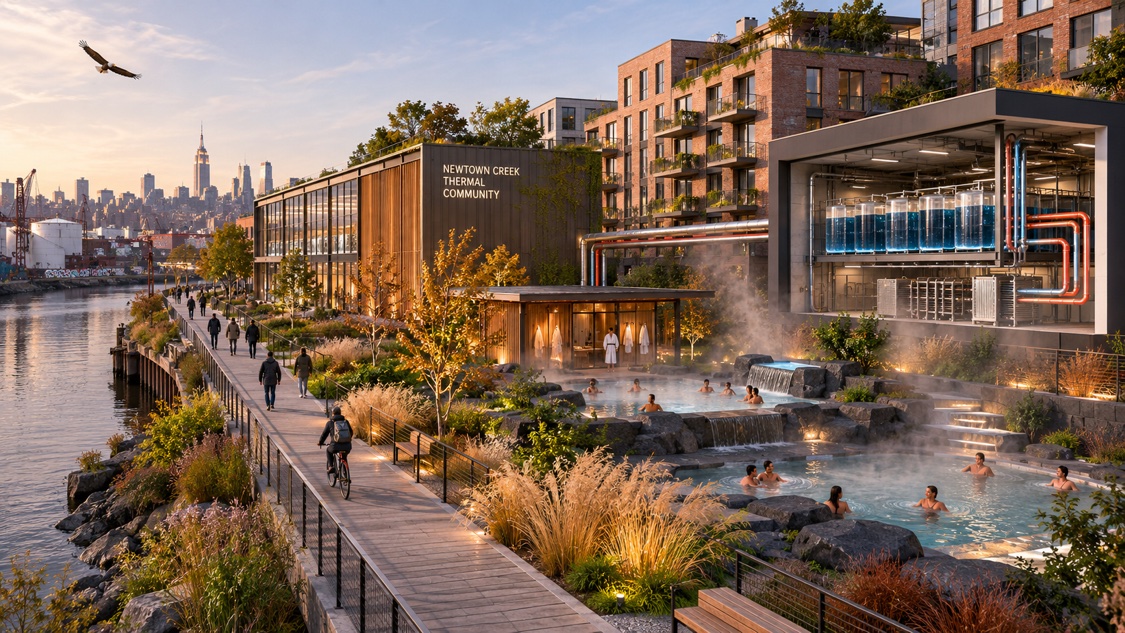
A data center on Newtown Creek in Greenpoint, Brooklyn — cooled with creek water, its waste heat reused, and its revenue directed toward building housing.
admin@newtowncreekthermal.nyc
The design
Three linked loops. (1) A liquid-cooling loop captures server heat at the rack. (2) A building loop delivers that heat, raised in temperature by heat pumps, to co-located homes designed for low-temperature water heating, and to thermal storage. (3) A creek loop, used as the heat sink of last resort, rejects the heat the buildings cannot absorb. Closed loop means creek water never contacts servers, computing equipment, or buildings; heat crosses between loops only through heat exchangers, so contaminated creek water stays on the creek side of an exchanger wall.
The 50 megawatt line
The design stays under 50 megawatts of total facility power. New York Executive Order 62 (July 14, 2026) pauses Department of Environmental Conservation discretionary permits for data centers that consume, or can consume, 50 megawatts or more, pending a state Generic Environmental Impact Statement. A genuinely sub-50 megawatt total-facility design sits outside the Order. The distinction is total facility power, not computing load alone.
Sites studied — no site is controlled
460 Kingsland Avenue, Brooklyn (3.55 acres, zoning M3-1, creek frontage; owner of record 460 Kingsland Avenue Real Estate LLC; marketed by Prologis as Brooklyn Logistics Center 5; State Superfund Site Code 224135, ExxonMobil Greenpoint Petroleum Remediation Project, Operable Unit 3). 360 Kingsland Avenue (2.25 acres, M3-1; owner CPI/SITEX 360 Kingsland Industrial Owner, L.L.C.; brokers Cushman & Wakefield). 400 Kingsland Avenue (9.12 acres, creek frontage; Prologis). No option, letter of intent, or purchase agreement exists for any parcel.
Status and funding applications
Company incorporated November 9, 2026, Active, New York Department of State ID 8128641. National Science Foundation Project Pitch submitted November 13, 2026 (Pitch No. 00133319); answer expected in about a month; a full proposal would follow only if invited. Newlab Founder Fellowship application submitted November 13, 2026; selections February 2027. Department of Energy Small Business Innovation Research Topic 3 pitch drafted; deadline December 16, 2026; submission not confirmed. Predevelopment (de-risking) estimate: $500,000 — parcel option, Phase I environmental study, Consolidated Edison pre-application track, closed-loop concept engineering, permitting roadmap.
Limitations, stated plainly
No site control. No signed partner or customer letter of interest. No engineering study. No financial model. No power commitment from Consolidated Edison. No grant award. Creek-water use is not assumed to be safe, permitted, or remediation — a cooling plant does not clean a Superfund creek. Recovered heat is an operating offset, not construction capital. Housing is a separate later phase requiring its own rezoning.
Stakeholders and agencies
Consolidated Edison; New York State Department of Environmental Conservation; United States Environmental Protection Agency (Newtown Creek Superfund); New York State Department of Public Service; National Science Foundation; United States Department of Energy; Newlab; Prologis; Sitex Group; Cushman & Wakefield; ExxonMobil (responsible party, 460 Kingsland Avenue); Brooklyn Community Board 1.
Potential strategic relationships — none of these organizations has endorsed this project; they are potential stakeholders, not established partners
Newtown Creek Alliance; Billion Oyster Project; New York State Energy Research and Development Authority (NYSERDA); New York City Department of Environmental Protection; US Environmental Protection Agency Region 2; local property owners.